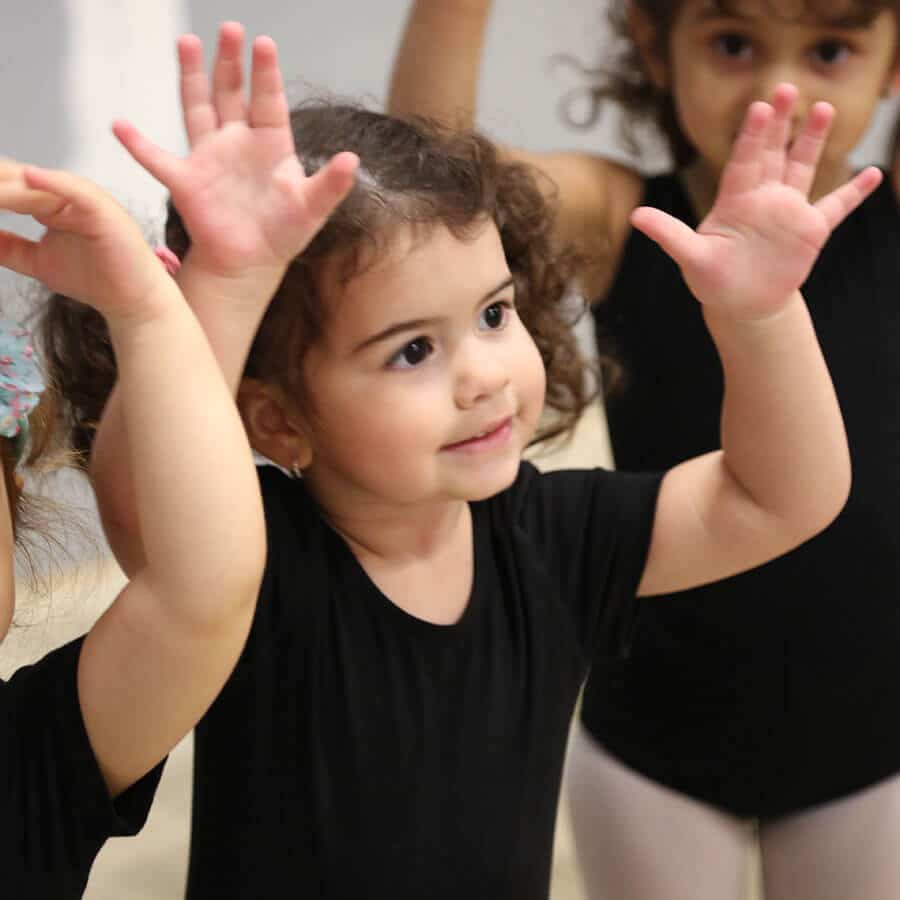
Most parents don’t think twice about signing a toddler up for a structured dance class—where an instructor demonstrates a move and kids do their best to copy it. And there’s nothing wrong with that. But creative dance for toddlers unlocks something that structured choreography alone simply can’t: a critical developmental window where free, exploratory movement shapes the brain itself.
Creative dance uses open-ended imagery and prompts to guide movement rather than fixed steps. When a teacher says, “Move like a melting ice cream cone,” there’s no right or wrong response. That ambiguity is the entire point. The child has to interpret the idea, translate it into movement, and execute it—all in real time. That process is quietly doing extraordinary things for your toddler’s developing brain, balance, and problem-solving ability.
How Does Creative Dance Help with Brain Development? Bilateral Integration and Crossing the Midline
One of the most important—and least talked about—benefits of creative dance for children is how it develops bilateral integration: the brain’s ability to coordinate both sides of the body at the same time. This skill matters far beyond the dance floor. Bilateral integration underpins future academic skills like reading (tracking text from left to right) and writing (where the non-dominant hand stabilizes the page while the other writes).
Here’s the difference in practice. Jumping on two feet is a symmetrical movement—both sides of the body do the same thing simultaneously. Hopping on one foot while waving the opposite arm is asymmetrical, and far more demanding neurologically. Asymmetrical creative movements require the left and right hemispheres of the brain to communicate through a structure called the corpus callosum.
Crossing the body’s midline—the imaginary vertical line dividing the body into left and right halves—is what forces that communication. A simple creative prompt like, “Pretend you’re a giant windshield wiper,” or “Reach across and paint the wind” naturally gets toddlers crossing that midline without even realising they’re doing it.
Toddler Balance Activities: The Vestibular System and Proprioception
Balance doesn’t come naturally to toddlers—and for good reason. They’re top-heavy by design, with larger heads relative to their bodies, and their balance systems are still developing. Creative dance is one of the most effective toddler balance activities available because it constantly challenges two hidden senses that keep us upright.
The vestibular system, housed in the inner ear, tracks balance and the body’s relationship to gravity. Proprioception refers to the awareness of where your limbs are in space without needing to look at them—knowing your arm is raised, for instance, without glancing at it. Creative movement trains both by constantly altering a child’s height, speed, and axis of movement.
A great example is a variation of the classic “freeze” game. Kids run freely around the room, then must stop instantly and balance on one foot when the music cuts out. That sudden halt forces the brain to rapidly calculate equilibrium and override the body’s momentum. It’s genuinely demanding neuromuscular work—wrapped up in something that feels like pure fun.
Understanding Space: Teaching Toddlers About Bubbles and Pathways
If your toddler regularly walks into furniture or bumps into other kids, that’s completely normal. Toddlers are still in the process of mapping the physical world around them. They’re learning how much space their bodies occupy and how to navigate through a room without collision.
Creative dance addresses this directly through the concept of self-space (sometimes called the kinesphere—the personal bubble of space immediately surrounding the body) versus general space (the shared area everyone moves through). One of the most effective ways to teach this is the “soap bubble” game: each child imagines they’re standing inside a fragile soap bubble and must move around the room without letting their bubble pop against a wall or a friend. It’s immediately intuitive to a toddler’s imagination, and it teaches spatial boundaries without a single rule needing to be spelled out.
Creative Movement for Preschoolers: The “Ice Cube Challenge” and Executive Function
This is where creative movement for preschoolers really earns its place as a cognitive workout. Executive function—the set of mental skills that includes working memory, cognitive flexibility, and inhibitory control—is one of the strongest predictors of academic and social success. And creative dance builds all three at once.
Consider what actually happens when a child is told to, “Dance like an ice cube melting on a hot day”:
- Inhibition: They must stop whatever fast, energetic movement they were doing.
- Working memory: They hold the abstract concept of melting in mind while their body responds.
- Cognitive flexibility: They translate a thermal concept—heat, slowness, liquefaction—into a physical, muscular experience of gradually sinking toward the floor.
Compare that to memorized choreography. Recalling a set sequence of steps is passive recall; it draws on memory, but it doesn’t require a child to problem-solve in real time. Creative prompts do. Each new image demands a fresh solution, making every class a genuine exercise in flexible thinking.
Quick Guide: What to Expect at Each Age and Stage
Every toddler develops at their own pace, but creative dance tends to follow a recognizable progression. Here’s a general overview of what each stage looks like:
| Age | What to Expect |
| 1–2 years | Simple locomotion (walking, swaying), discovering body parts (“Can your knees dance?”), using simple props like shaker eggs to connect music and movement |
| 2–3 years | Exploring level changes (low to the ground vs. reaching up high), contrasting concepts like heavy vs. light—stomping like a giant or tiptoeing like a mouse |
| 3–4 years | Abstract themes like dancing an emotion (happy, spooky, sleepy), following multi-step imagery, and beginning to move near peers without colliding |
How to Bring Creative Dance Home: A Parent’s Playbook
You don’t need a studio to introduce creative dance. A cleared living room and a few minutes of music are enough to get started. A few tips to make it work:
Ditch “Watch me and copy.” Open-ended questions are far more effective. Instead of demonstrating how to walk like an elephant, ask, “How do you think a really heavy elephant might walk?” Let your child work it out.
Rethink your playlist. Generic nursery rhymes are fine, but toddlers respond beautifully to variety. Try jazz for its surprising syncopations, classical music for sweeping, large movements, and percussion-heavy tracks for strong, grounded rhythm tracking. The more varied the music, the richer the movement vocabulary your child develops.
Raid the house for props. Tissue paper encourages light, floating movements. An empty cardboard box opens up a world of inside/outside/under exploration. A long scarf becomes a river, a storm, or a dragon’s tail. Simple props give children a concrete starting point for abstract movement.
Finding the Right Kids’ Dance Studio in Toronto
Creative dance isn’t filler—and it’s not just something to do on a rainy afternoon. It’s a sophisticated developmental tool that builds the cognitive architecture, balance systems, and problem-solving skills your toddler needs for learning, socializing, and growing with confidence.
So, the next time your little one is spinning in circles and flailing their arms to the beat, know that something meaningful is happening. They’re mapping space, training their vestibular system, exercising executive function, and building the foundations for skills that will serve them for years to come.
If you’d like to see what structured creative dance looks like in a real studio environment, Performing Dance Arts offers programs designed specifically for this age group. Our Dance in Your Pants program (ages 2–3) and Pre-Dance classes (ages 3–5) introduce young children to movement exploration in a supportive, age-appropriate setting. Families looking for dance classes in Toronto, Vaughan, or Etobicoke can explore these programs at Performing Dance Arts and discover a fun, engaging way for their child to move, learn, and grow.